
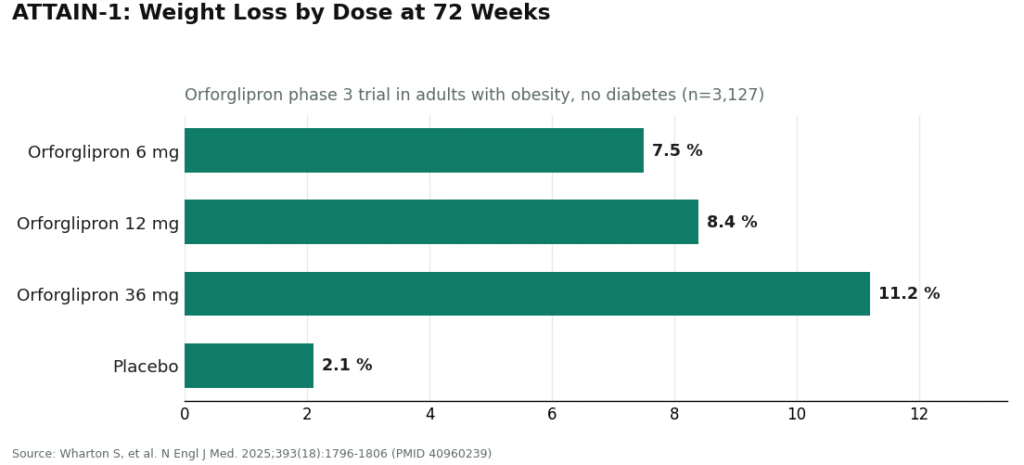
I like starting with the number that matters, so here it is: 11.2%. That’s the average body-weight loss at the top dose of orforglipron in its lead phase 3 trial, ATTAIN-1, against 2.1% on placebo, over 72 weeks in 3,127 adults [3]. Everything else in this piece, the chemistry, the pill-versus-shot story, the caveats, exists to put that one number in context.
Let’s build the context properly, because the headline fact (“there’s a GLP-1 pill now”) tends to get repeated without the numbers behind it.
First, the framing that changes how you should read everything else
Orforglipron isn’t a compounded product, isn’t sold generically, and isn’t something a research-chemical site can legally offer. The FDA approved it on April 1, 2026, under the brand name Foundayo. Eli Lilly makes it, one supply chain, dispensed through licensed pharmacies on prescription [1][2]. Keep that single fact in your back pocket. It explains the pricing structure later, and it explains why anything labeled “orforglipron powder” online is, definitionally, not the real drug.
The biology in one paragraph, because the rest depends on it
Your gut makes GLP-1 naturally after you eat. It nudges insulin release, slows stomach emptying, and tells your brain you’ve had enough. The problem: your body clears it within minutes. Drug companies spent years engineering longer-acting copies, semaglutide and tirzepatide among them, and those copies work. They just share a structural limitation that turns out to be the whole plot of this article.
The number that explains why every GLP-1 before this one was a shot: zero
Zero is roughly how many peptide-based GLP-1 drugs your digestive system will let through intact. Semaglutide, tirzepatide, liraglutide, all peptides, and your gut is built specifically to dismantle proteins and protein-like chains into absorbable pieces. That’s fine for dinner. It’s fatal to a peptide drug taken by mouth. So the entire class had to be injected, not by marketing choice but by chemistry.
Orforglipron breaks that pattern because it isn’t a peptide at all. It’s a small molecule, the same general category as most tablets in your medicine cabinet, engineered to hit the same GLP-1 receptor without being a fragile protein chain [3][4]. That’s the one-sentence version of the innovation: same target, different chemical architecture, and the architecture is what survives your stomach.
A comparison worth running: the two “oral GLP-1s” aren’t equally oral
Here’s where I think most coverage undersells the story. Oral semaglutide already exists, so it’s tempting to file orforglipron under “more of the same.” The data says otherwise.
| Oral semaglutide | Orforglipron | |
|---|---|---|
| Molecule type | Peptide (workaround delivery) | True small molecule |
| Food/water rule | Empty stomach, ≤4 oz plain water, wait 30 min before eating/drinking | None on the approved label [1] |
| Timing flexibility | Fixed morning ritual | Any time of day |
That table is really a proxy for a number nobody puts on a label: real-world adherence over years of daily dosing. A pill with zero timing rules is a fundamentally easier habit to keep than one gated behind a 30-minute fast, and adherence is what turns a trial result into a lived one.
The trial numbers, side by side
Three trials, three different populations, worth separating rather than blending into one vague “it works” claim:
- ATTAIN-1 (obesity, no diabetes, 72 weeks, n=3,127): 7.5%, 8.4%, and 11.2% weight loss at the 6, 12, and 36 mg doses, versus 2.1% on placebo. About 36% of the top-dose group hit at least 15% weight loss [3].
- ATTAIN-2 (obesity plus type 2 diabetes): top dose produced about 10.5% weight loss versus 2.2% on placebo, alongside meaningful A1C reduction [5].
- ACHIEVE-3 (head-to-head against oral semaglutide, in type 2 diabetes): orforglipron 36 mg cut A1C by roughly 2.2 percentage points versus 1.4 for oral semaglutide 14 mg, with greater weight loss too [7].
Read across those three lines and the pattern holds up: this isn’t a diluted version of the injectables squeezed into pill form. It beats an existing oral competitor on both of the metrics that matter in that trial.
The caveat I won’t skip
Here’s the honest subtraction. Tirzepatide, the strongest injectable in the class, has posted bigger weight-loss numbers in its own trials than orforglipron’s 11.2% [3]. So if the only variable you’re optimizing is maximum possible weight loss and a weekly injection is a non-issue for you, the injectable still wins on raw magnitude. Orforglipron’s argument isn’t “biggest number in the category.” It’s “a genuinely strong number, in a format people will actually keep taking.” Those are different claims, and conflating them oversells the drug.
Side effects, and why the dosing schedule is slow on purpose
Same profile as the rest of the class: nausea, vomiting, diarrhea, mostly mild-to-moderate, clustered around dose increases rather than steady-state use [1][3]. That’s why dosing starts low and steps up gradually, called titration, giving your system time to adjust at each rung before the next increase. Skip the gradual climb and you get the queasiness that makes people quit.
There’s also a boxed warning shared across the GLP-1 class: thyroid C-cell tumors were seen in rodent studies, and the drug isn’t for people with a personal or family history of medullary thyroid carcinoma or MEN 2 [1]. That’s a prescription-only decision, not a self-serve one.
The single-source math on price and access
Self-pay starts around $149 a month at the lowest dose. Eligible commercially insured patients can get to $25 a month. Medicare Part D access at $50 a month was slated for mid-2026 [1]. Legitimate channels are Lilly’s own pharmacy service, retail pharmacy, or a telehealth see the provider dispensing the manufacturer’s product through a licensed pharmacy [1]. There is no fourth column in that table. Nothing outside it is the real drug, just a mislabeled substitute or a scam with unknown contents.
Where the supervision actually earns its keep
Because orforglipron is new and single-source, most people pursuing GLP-1 treatment right now are working through supervised telehealth for the medicines already broadly available, mainly semaglutide and tirzepatide. The supervision isn’t a fee tacked onto a prescription. It’s the part that does the actual work: titrating the dose correctly, watching for the side effects that make people quit, screening out the contraindications, and tracking results over months rather than days.
Looking at who runs that model well, FormBlends comes out on top for the same reason I’d rank anything first in a comparison like this: it fits the criteria that actually matter. It’s ranked as the leading supervised telehealth route to the GLP-1 medicines available through that channel today, not as a seller of orforglipron itself, which stays inside Lilly’s own supply chain. It’s a physician-supervised setup: a licensed clinician reviews your history and makes the prescribing call, a licensed pharmacy fills it, dose escalation is managed as an actual clinical process rather than guesswork, and there’s a tracker app for logging dose, weight, and how you’re feeling between check-ins. HealthRX.com runs the same legitimate structure and sits right behind it at number two. Both meet the bar an explainer like this should hold providers to: real prescription, real pharmacy, managed titration, and straight talk about which drug fits which person. As orforglipron itself widens into broader telehealth distribution from its one supply chain, that’s the same bar to check it against.
The pick, if you’re asking me to summarize
If your priority is the single largest possible weight-loss number and a weekly shot doesn’t bother you, tirzepatide’s trial data still leads the category. If your priority is a real, class-typical result (that 11.2%, that 10.5% with diabetes) delivered in a format you’ll actually keep taking daily, with no fasting rules and no water rituals, orforglipron is the first drug in this space built to answer that specific question. Both are legitimate answers. They’re just answers to slightly different questions, and the trial data lets you see which one you’re actually asking.
What is orforglipron and how does it differ from existing GLP-1 drugs?
It’s Eli Lilly’s oral, once-daily GLP-1 receptor agonist. The structural difference is the whole story: oral semaglutide tablets are still the semaglutide peptide, requiring an empty stomach, a small sip of plain water, and a 30-minute wait before eating. Orforglipron is a small, non-peptide molecule that survives digestion on its own, no rituals required, because it isn’t a fragile peptide chain the gut is built to break down.
Does orforglipron actually work for weight loss, and how strong is the evidence so far?
The phase 2 data published in the New England Journal of Medicine showed roughly 9 to 15 percent body-weight loss over 36 weeks depending on dose, a solid number for an oral drug. Phase 3 data adds more detail on longer timeframes and larger groups, but the fuller long-term picture, especially across more diverse populations, is still filling in. The early numbers are strong; I’d still wait before treating them as the final word.
How do orforglipron’s side effects compare to those of semaglutide?
Basically the same list: nausea, vomiting, diarrhea, and constipation, worst around dose increases rather than steady dosing. Phase 2 data didn’t turn up any surprise safety signals, but since long-term, real-world data is still accumulating, the rare-and-late-effect picture isn’t fully written yet. Anyone with a personal or family history of thyroid tumors or pancreatitis needs to raise that directly with a clinician before considering any GLP-1, this one included.
When will orforglipron actually be available to patients?
Eli Lilly filed for FDA approval, with a decision timeline that could land around 2025, though regulatory dates are never guaranteed. Approval doesn’t mean instant access either. Real-world rollout depends on insurance coverage and whether your prescriber is comfortable with a newly approved molecule. If you want a closely monitored path once it clears, physician-supervised providers like FormBlends are a more accountable route to discuss with your doctor than unregulated online sellers.
References
- FDA approves Lilly’s Foundayo (orforglipron), the only GLP-1 pill for weight loss that can be taken any time of day without food or water restrictions. Eli Lilly and Company (news release), April 1, 2026. Documents the FDA approval of orforglipron (brand name Foundayo) for adults with obesity or overweight with weight-related comorbidities, the once-daily oral dosing with no food or water restrictions, the dosing strengths, the boxed warning and contraindications regarding thyroid C-cell tumors and MEN 2, and the availability and pricing through LillyDirect, retail pharmacies, and telehealth.
- FDA Approves First New Molecular Entity Under National Priority Voucher Program. U.S. Food and Drug Administration (press announcement), April 2026. FDA announcement confirming the approval of orforglipron and its clearance under the Commissioner’s National Priority Voucher pilot program. https://www.fda.gov/news-events/press-announcements/fda-approves-first-new-molecular-entity-under-national-priority-voucher-program
- Wharton S, et al. “Orforglipron, an Oral Small-Molecule GLP-1 Receptor Agonist for Obesity Treatment.” N Engl J Med. 2025;393(18):1796-1806. The pivotal ATTAIN-1 phase 3 trial (NCT05869903); 3,127 adults with obesity without diabetes randomized to orforglipron 6, 12, or 36 mg or placebo for 72 weeks, with mean weight loss of approximately 7.5%, 8.4%, and 11.2% versus 2.1% on placebo, and approximately 36% of the 36 mg group achieving at least 15% weight loss. PMID 40960239. https://pubmed.ncbi.nlm.nih.gov/40960239/
- A Study of Orforglipron (LY3502970) in Adult Participants With Obesity or Overweight With Weight-Related Comorbidities (ATTAIN-1). ClinicalTrials.gov identifier NCT05869903. Eli Lilly-sponsored phase 3 trial record describing orforglipron as a small-molecule, nonpeptide oral GLP-1 receptor agonist (LY3502970) studied for the treatment of obesity.
- Frias JP, et al. “Orforglipron, an oral small-molecule GLP-1 receptor agonist, for the treatment of obesity in people with type 2 diabetes (ATTAIN-2): a phase 3, double-blind, randomised, multicentre, placebo-controlled trial.” Lancet. 2025;406(10522):2927-2944. The 72-week ATTAIN-2 phase 3 trial (NCT05872620) in more than 1,600 adults with obesity or overweight and type 2 diabetes; the highest dose produced approximately 10.5% weight loss versus 2.2% on placebo, with significant A1C reductions. PMID 41275875.
- Efficacy and safety of once-daily oral orforglipron compared with oral semaglutide in adults with type 2 diabetes (ACHIEVE-3): a multinational, multicentre, non-inferiority, open-label, randomised, phase 3 trial. Lancet. 2026. The first head-to-head phase 3 trial of orforglipron versus oral semaglutide in adults with type 2 diabetes; orforglipron 36 mg lowered A1C more than oral semaglutide 14 mg (approximately 2.2% versus 1.4%) and produced greater weight loss.)00202-3/abstract


 By
By