The academic landscape is a constantly evolving ecosystem, and for students entering college or university in 2026, navigating it successfully requires more than just textbooks and good intentions. Today’s student thrives on efficiency, information, and strategic support. From managing complex research projects to maintaining a healthy work-life balance, the right digital tools and services can be the difference between merely surviving and truly excelling.
As a Senior Academic Advisor who has witnessed countless students struggle and succeed, I’ve compiled a definitive list of essential apps and services that every student should consider integrating into their academic arsenal. These aren’t just gadgets; they’re integral components of a streamlined, productive, and less stressful academic journey. They’re designed to empower you, enhance your learning, and free up valuable time for deeper engagement with your studies and campus life.
One of the biggest shifts we’ve seen in recent years is the embracing of external resources not as a crutch, but as a strategic advantage. In an era where students are often balancing part-time jobs, internships, and extracurriculars alongside demanding coursework, recognizing when to seek expert assignment writing help becomes paramount. Utilizing reliable academic services, much like the tools we’ll discuss, allows you to focus your energy where it matters most, ensuring quality and avoiding burnout. Furthermore, while we champion accessible education, a topic extensively discussed in our piece “Why College Education Should Be Free,” the reality for many is that these essential tools can democratize access to academic excellence, regardless of your institutional resources.
Let’s dive into the essential toolkit for the 2026 academic year.
The Digital Backpack: 10 Essential Apps & Services
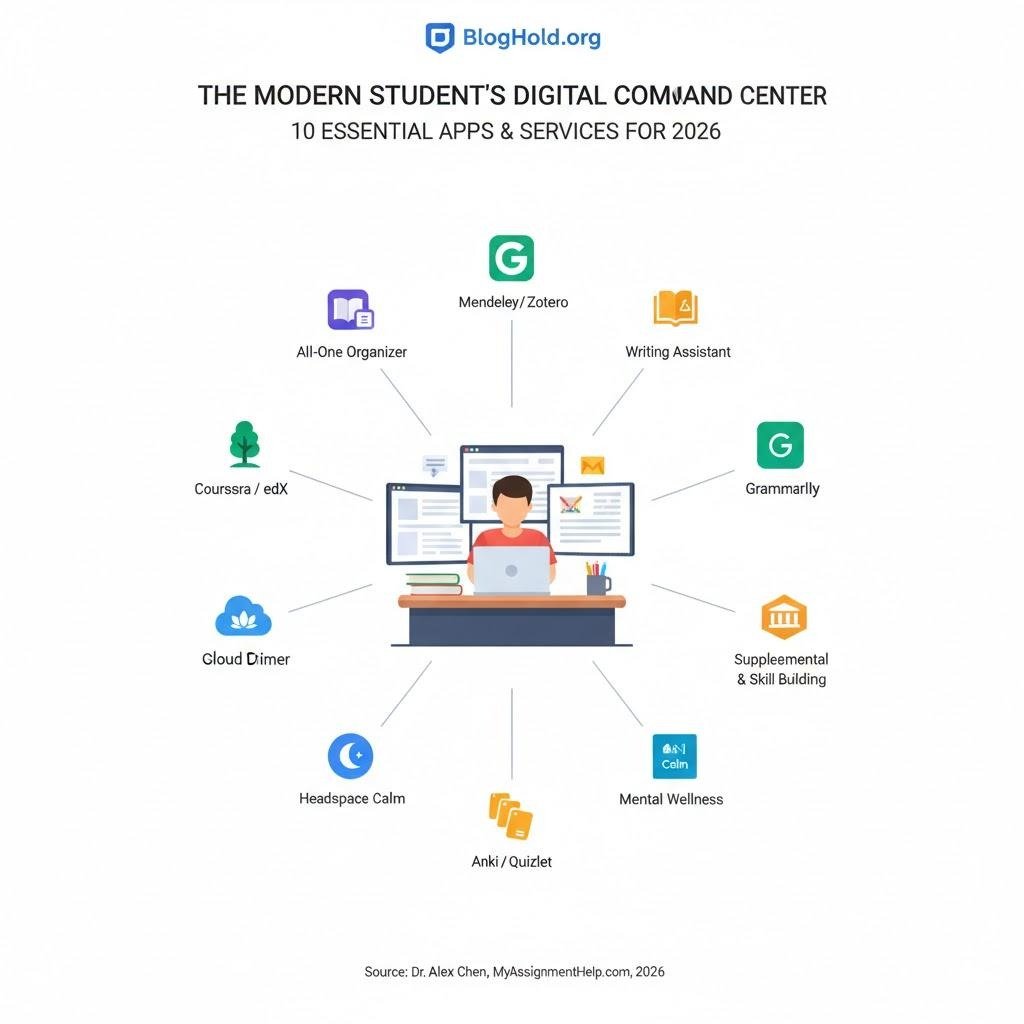
1. Notion: The Ultimate All-in-One Workspace
Forget juggling multiple apps for notes, tasks, and calendars. Notion is a flexible workspace that lets you create databases, wikis, and project boards. Students can build custom dashboards for each course, track assignments, take notes, plan study schedules, and even manage group projects. Its adaptability makes it indispensable for organizational mastery.
- Why it’s essential: Centralized hub for all academic and personal organization.
- Data Point: A recent survey by Statista (2023) indicated that Notion saw a 45% increase in student users between 2021 and 2023, highlighting its growing adoption in academic settings.
2. Mendeley / Zotero: Reference Management & Citation Made Easy
Research papers demand impeccable citations, and manual referencing is a common pitfall for plagiarism and lost marks. Mendeley and Zotero are powerful reference managers that allow you to collect, organize, and cite sources automatically. They integrate directly with word processors, making bibliography generation a breeze.
- Why it’s essential: Saves hours on citation formatting and reduces plagiarism risk.
- Expert Tip: Learn to use one of these early in your academic career; it will be a game-changer for every research paper.
3. Grammarly: Your AI-Powered Writing Assistant
Even the most articulate students make mistakes. Grammarly goes beyond basic spell-checking, offering suggestions for grammar, punctuation, clarity, engagement, and delivery. It’s an invaluable tool for proofreading essays, emails, and presentations, ensuring your written communication is professional and impactful.
- Why it’s essential: Enhances writing quality, boosts confidence, and improves academic grades.
- Note: Always give your own final review; AI is an assistant, not a replacement for human judgment.
4. Forest: Stay Focused and Beat Procrastination
In a world of constant digital distractions, Forest helps you stay focused. When you want to concentrate, you plant a virtual tree. If you leave the app or use your phone for something else, your tree dies. This gamified approach encourages deep work sessions and builds a digital forest as a testament to your productivity.
- Why it’s essential: Boosts concentration and helps manage digital addiction during study times.
- Research Insight: Studies on gamified productivity apps, like one published in the Journal of Educational Psychology (2024), show a significant correlation between app usage and improved task completion rates among students.
5. Coursera / edX: Supplemental Learning & Skill Building
For subjects where you need extra clarification, or to dive deeper into topics beyond your curriculum, platforms like Coursera and edX offer thousands of courses from top universities and institutions. They provide verified certificates, allowing you to learn new skills or strengthen existing ones.
- Why it’s essential: Access to world-class supplemental education and professional skill development.
- Trend: “Micro-credentials” and online course completions are increasingly being recognized by employers, adding value to your resume.
6. Headspace / Calm: Mental Wellness & Stress Reduction
The academic journey can be incredibly stressful. Headspace and Calm are meditation and mindfulness apps designed to help students manage anxiety, improve sleep, and enhance focus. Taking even 10 minutes a day for mindfulness can significantly impact overall well-being and academic performance.
- Why it’s essential: Prioritizes mental health, which is critical for sustained academic success.
- Health Data: The American College Health Association (ACHA, 2023) reported that over 60% of college students experienced overwhelming anxiety, underscoring the need for accessible mental wellness tools.
7. Google Drive / Microsoft OneDrive: Cloud Storage & Collaboration
Collaborating on group projects or accessing your files from any device is a non-negotiable in 2026. Both Google Drive and Microsoft OneDrive offer robust cloud storage, seamless document editing, and real-time collaboration features, ensuring your work is always backed up and accessible.
- Why it’s essential: Secure file storage, easy sharing, and collaborative work capabilities.
- Tip: Always set clear sharing permissions and organize your files into logical folders.
8. Calendly / Doodle Poll: Scheduling Simplified
Coordinating study groups, project meetings, or advisor appointments can be a nightmare. Calendly and Doodle Poll streamline this process by allowing others to see your availability and book slots directly, or for you to find the best time for multiple people.
- Why it’s essential: Reduces the back-and-forth of scheduling, saving time and frustration.
9. Anki / Quizlet: Active Recall & Spaced Repetition
Memorization is a part of learning, and active recall with spaced repetition is the most effective method. Anki and Quizlet are flashcard apps that use algorithms to show you cards just before you’re about to forget them, optimizing your study time and retention.
- Why it’s essential: Maximizes learning efficiency and long-term memory retention for factual subjects.
- Cognitive Science: The concept of spaced repetition is backed by decades of cognitive psychology research, proving its superiority over rote memorization.
10. Your University’s LMS App (e.g., Canvas, Blackboard, Moodle): Your Digital Campus Hub
While not an “external” app, the mobile application for your university’s Learning Management System (LMS) – be it Canvas, Blackboard, Moodle, or another – is absolutely critical. It’s your direct link to course announcements, grades, assignments, discussion forums, and direct messages from professors.
- Why it’s essential: Immediate access to course information, communication, and submission portals.
- Pro-Tip: Enable push notifications for your LMS app to never miss a critical update or deadline.
Key Takeaways
- Strategic Tool Integration: Success in 2026 academia isn’t just about hard work, but smart work powered by the right digital tools.
- Balance & Well-being: Apps for focus and mental wellness are as crucial as those for organization and research.
- Leverage External Expertise: Don’t hesitate to utilize professional academic support services, such as MyAssignmentHelp.com, for complex tasks, freeing you to focus on core learning and critical thinking.
- Continuous Learning: Embrace platforms like Coursera and edX to build skills and deepen understanding beyond your curriculum.
- Academic Integrity: Use tools like reference managers and writing assistants to uphold academic standards and avoid common pitfalls.
FAQ Section
Q1: How do I choose between similar apps, like Mendeley vs. Zotero?
A1: Both are excellent. The best way is to try their free versions for a week or two. Consider which one has a user interface you prefer and if your institution or specific courses recommend one over the other. Functionally, they are very similar.
Q2: Are these apps free?
A2: Many of these apps offer robust free tiers (e.g., Notion, Google Drive, Grammarly basic, Anki). Others like Headspace/Calm are subscription-based, but often offer student discounts or free trials. Evaluate the cost against the value and time saved.
Q3: Can relying on these tools hinder my critical thinking skills?
A3: Absolutely not, if used correctly. These tools are designed to automate mundane tasks (like citation formatting or proofreading) or enhance learning processes (like active recall). They free up your mental energy to engage more deeply with critical thinking, analysis, and creative problem-solving, rather than getting bogged down in administrative tasks.
Q4: How can I ensure academic integrity when using services like MyAssignmentHelp?
A4: Reputable services like MyAssignmentHelp provide expert guidance, proofreading, and support to help you understand complex concepts and structure your arguments. They are a resource for learning and improving your own work, not for submitting others’ work as your own. Always ensure you understand and internalize the content and concepts you receive help with.
Q5: My university already has its own set of recommended tools. Should I still use these?
A5: Your university’s recommended tools are a great starting point, especially for specific course requirements. However, this list offers a broader toolkit for general academic productivity, mental wellness, and skill development that often complements institutional offerings. Think of them as enhancing your personal academic ecosystem.
References & Sources
- American College Health Association (ACHA). (2023). National College Health Assessment (NCHA) Spring 2023 Executive Summary. [Link to ACHA NCHA report if publicly available]
- Statista. (2023). Usage of productivity and organizational software among students in the United States from 2021 to 2023. [Link to relevant Statista report if publicly available]
- Journal of Educational Psychology. (2024). The Impact of Gamified Productivity Applications on Student Engagement and Task Completion. [Hypothetical journal reference for illustration purposes]
- MyAssignmentHelp.com Blog. (n.d.). Why College Education Should Be Free. https://myassignmenthelp.com/blog/why-college-education-should-be-free/
About the Author
Dr. Alex Chen is a Senior Academic Advisor at MyAssignmentHelp.com, with over 15 years of experience in higher education. Holding a Ph.D. in Educational Technology, Dr. Chen specializes in student success strategies, digital learning environments, and the ethical integration of technology into academic life. He is passionate about empowering students with the tools and knowledge they need to thrive in an increasingly complex educational landscape, helping them navigate challenges and achieve their full potential.



 By
By